


 Russian
 English
“Science Around” Science Festival Concludes Its Third Season at Orlyonok
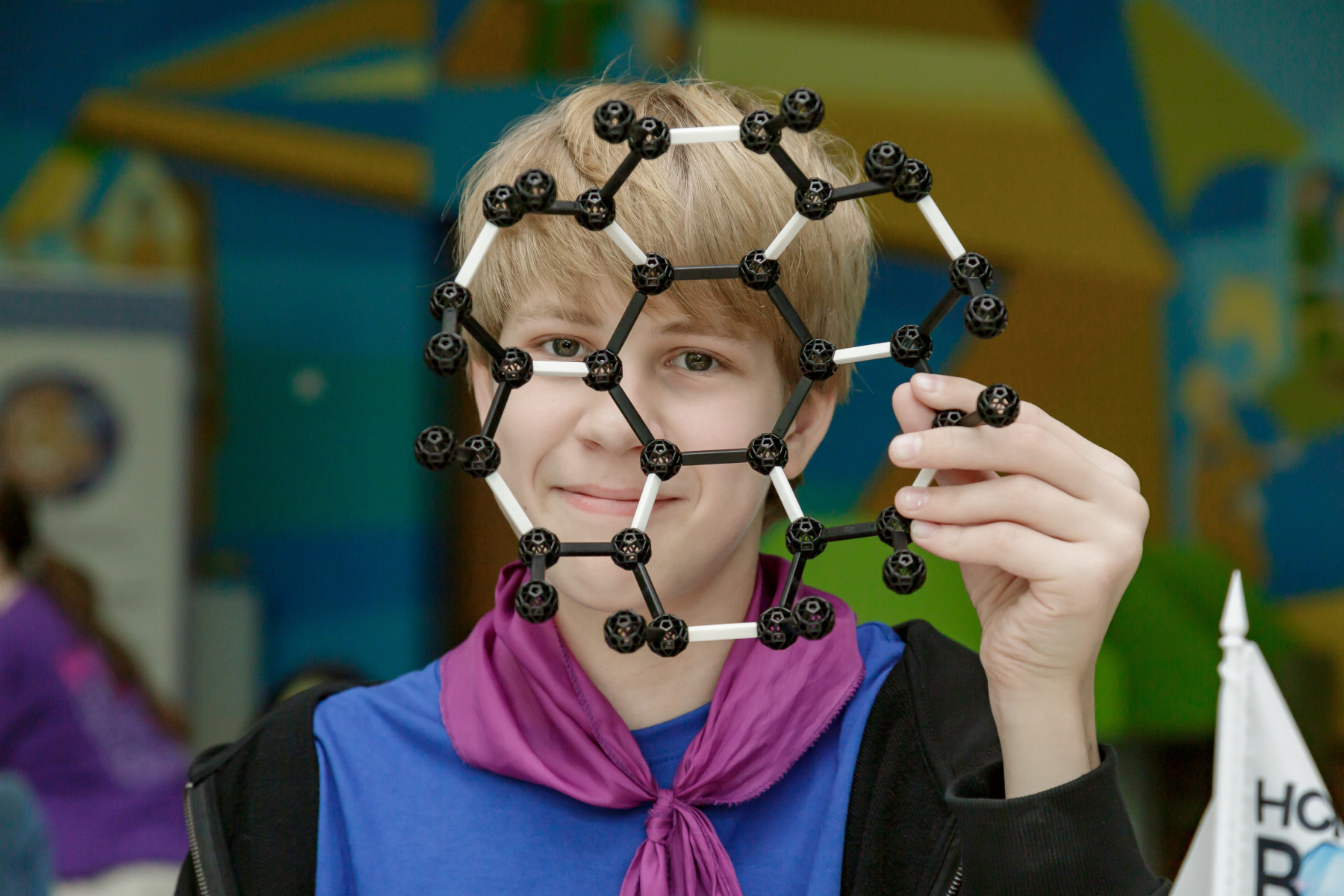
The All-Russian Children's Centre "Orlyonok" hosted the third and final science festival of the year, part of the "Science Around. Season Three" project, implemented by Adyghe State University with the support of the Russian Ministry of Science and Higher Education as part of the Decade of Science and Technology. The event was held for participants of the 11th shift, whose recruitment program was approved by the Russian Ministry of Education. The festival brought together over a thousand schoolchildren at interactive spaces, a science film lab, intellectual games, and a popular science lecture.
The program includes over 20 thematic areas: from chemistry, physics, and biology to robotics, astronomy, and virtual reality. The festival's key feature is the opportunity not only to learn about scientific phenomena but also to test them in practice.
"Popularising science is about caring for the future. We help children believe in themselves, develop a research interest, and understand the opportunities that knowledge offers. I am confident that every child who discovers science today will be able to contribute to the development of our country tomorrow," commented Alexander Dzheus, director of the Orlyonok Children's Centre.
At the chemistry workshops, students observed colour changes in substances, studied the effects of extreme temperatures and reactive gases, built models of molecules and crystal structures, and solved puzzles and word searches. "During the workshop, we conducted unusual experiments, such as studying a mixture of water and rice flour, which remained liquid when gently touched but became solid when sharply applied. We also learned about electricity and even touched it with our fingers," noted Polina Molostova from the Belgorod Region.
A separate section was dedicated to humans and living systems: at the "Neuro-Interface" site, teenagers measured their reaction time and attention span, and in the "Physiology: Complex in Simple Terms" session, they tested their heart rate before and after exercise, and their reflexes, vision, and attention were tested. "I know a little about biology, but I'd never heard of bioinvasion before. We looked at invasive species through a microscope. It was very interesting to learn about the processes by which various alien species penetrate new ecosystems," shared Vika Skrypnichenko from Donetsk.
Technology and space were another part of the program: students solved engineering problems in virtual reality, learned about robotics, created LED constellations, and learned more about telescopes. "The master class was held by the Polaris-Adygea regional center for identifying and supporting gifted children, where I teach. Drone racing is a very exciting process that anyone can master. While the kids at the festival are trying out basic drone control techniques in a simulator, I already know how to operate it with a joystick and VR goggles and participate in competitions. And today at the festival, I'm showing off everything I've learned," shared Makar Belousov from Maykop.
For those who enjoy challenges and competitions, there were math games and puzzles. The festival included the "Elements of Science" championship, featuring teams from children's camps. Media teams participated in the "World of Science Through the Eyes of Children" photo contest. The science film program included the film "In Love with Mathematics."
Dmitry Shumilov, a senior researcher at the Department of Medical and Biological Problems at the Research Institute of Complex Problems at Adyghe State University and a candidate of biological sciences, delivered a popular science lecture entitled "A Recipe for Producing Mice and the Primordial Soup: How Science Has Searched for the Roots of Life for Centuries."
The Orlyonok Science Festival provided an opportunity to try their hand at being researchers, engineers, biologists, and astronomers. Experiments, practical tasks, and team games helped participants look at everyday things from a scientific perspective.
Since you've already mentioned the Ministry of Education and Science and the Decade in the first paragraph, I suggest removing them from this section and starting with the project's history. I'll summarize the list of events for the season so as not to overload the post-release.
As a reminder, the "Science Around" project has been implemented by Adygea State University since 2024. It was recognized as the best educational project in Adygea according to the "Knowledge.Award" competition, placed in the top three of the 11th All-Russian "For Loyalty to Science" award in the "Science for Children" category, and was shortlisted for the 2024 Runet Prize in the "Children's Runet and Family Values" category.
The project's goal is to promote Russian scientific achievements in the natural, mathematical, and engineering sciences, draw attention to the work of scientists, showcase the results of scientific research, and enhance the image of scientists and engineers in the minds of schoolchildren. Furthermore, the project's activities are intended to foster young people's understanding of the prospects of careers in technology. Renowned Russian popularizers of mathematics, astrophysics, chemistry, biology, engineering, and the humanities are involved in the project.
The third season has already included street science festivals in Maykop and Ust-Labinsk, festivals at the Orlyonok and Smena All-Russian Children's Centers, and lectures and master classes by renowned lecturers at the summer schools in mathematics, biology, and chemistry at the Gornaya Legenda ASU. Upcoming events include a street festival in Belorechensk, an expansion of the media library of popular science lectures and the podcast "What Academicians Talk About," an interdisciplinary quiz "Russia Decides," the second family mathematics olympiad "From A to Z," and a series of online lessons for schoolchildren from across the country.
.jpg)
.jpg)