Russian
 English
ASU Academic Council Sets Staffing Framework and Scholarship Allocations for Upcoming Academic Year
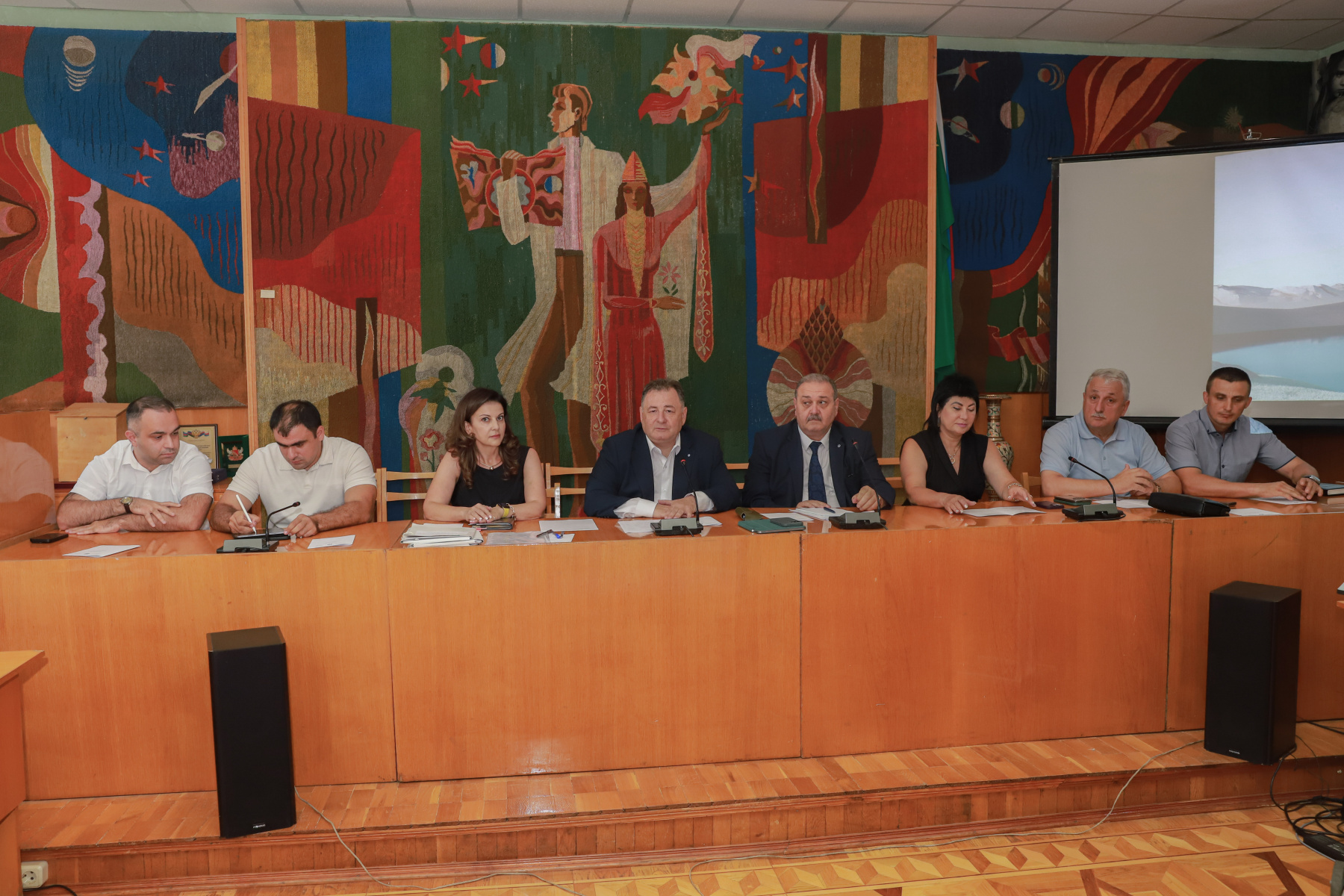
A meeting of the Academic Council was held at Adyghe State University. Participants discussed student social support, the results of summer educational projects, personnel changes, and strategic directions for the university's digital transformation.
New amounts of scholarship payments
Rustam Shkhachemukov , Vice-Rector for Youth Policy and Social Affairs, presented a report on the establishment of new scholarship amounts . Effective September 1, 2026, all scholarships at ASU will be indexed by 4% in accordance with recommendations from the Ministry of Science and Higher Education of the Russian Federation.
According to the calculations presented, the state academic stipend for undergraduate, specialist, and master's students has increased from 2,600 to 3,000 rubles. The enhanced academic stipend for outstanding achievements in academic and research activities has been increased from 15,600 to 18,000 rubles, and for achievements in cultural, creative, athletic, and social activities, from 10,400 to 12,000 rubles. The state social stipend has been increased from 3,900 to 4,500 rubles.
For postgraduate students, the state stipend for programs training scientific and pedagogical personnel has been increased from 5,800 to 7,500 rubles, and for those in areas determined by the Russian Ministry of Education and Science, from 13,700 to 15,000 rubles.
Personnel decisions
As their terms expired, elections were held for the heads of faculties and institutes. The current deans and director presented reports on the performance of their departments and their development programs for the new terms.
ollowing the vote, the Academic Council approved Nurbiya Pocheshkhov as Dean of the Faculty of History and Fatima Tuguz as Director of the Institute of Arts . Panesh Uchuzhuk has completed his tenure as Dean of the Faculty of Philology.
The Academic Council also re-elected the faculty. Those approved include Kazbek Chermit , Professor of the Department of Physical Education ; Olga Elnikova , Senior Lecturer of the Department of Physical Education; Mariet Naskurova , Associate Professor of the Department of Russian as a Foreign Language; Yulia Kopylova , Associate Professor of the Department of Foreign Languages; Rashid Khunagov , Professor of the Department of Philosophy and Sociology; and Irina Kireeva and Yaroslavna Demonova, Associate Professors of the Department of Philosophy and Sociology .
Summer schools at the Mountain Legend
Elena Kukva, Director of the Research Initiatives Department, presented a report on the summer schools held at the Gornaya Legenda ASU training facility. This year, three educational projects were held simultaneously at the facility: the Summer Methodological University, the second Summer School "How a Student Can Become a Mathematics Teacher," which was attended by 26 students from 13 Russian regions representing 17 universities, and the first Summer School of Renewable Energy Engineering Solutions.
"We gained a positive experience by bringing together different areas of expertise in one space. The project-based activities fostered active interaction and communication among the participants, and the projects the students developed will form the basis for their future research," noted Elena Kukva.
Participants worked with leading experts, including Fyodor Lukyanov , Scientific Director of the Valdai Discussion Club and host of the International Review program , who led the students through a business simulation of international relations.
Summing up the discussion of the summer schools, ASU Rector Daud Mamiy stated that the engineering focus and the involvement of federal-level experts will be further developed. "Students in the natural sciences must broaden their horizons and understand global processes. We will address this issue systematically," he concluded.
Digital development of the university
Vice Rector for Digital Transformation Azamat Pseush discussed project sessions with Modeus aimed at updating the university's educational model in the context of technological leadership. The company's experience in implementing individualized educational pathways, which it had previously successfully implemented at Tyumen State University, is now being adapted at ASU.
This summer, ASU also opened a Laboratory for Transforming Education through Artificial Intelligence Technologies. Three specialists from Tyumen State University, experienced in integrating AI into education, have been invited to work there. Ahmed Elghandur, head of the undergraduate education program office at the Skolkovo Moscow School of Management, has been appointed head of the laboratory .
Continuing the topic of digitalization, Azamat Pseush reported on work to create unified digital services for staff and students. "The university's digital ecosystem will be built on the principle of the State Services portal—with a single entry point for staff and students. We plan to complete this phase by the end of 2027," he explained.
The meeting also noted that ASU is actively engaging in the digital breeding agenda. At the invitation of the Russian Ministry of Agriculture, staff from the Laboratory of Mathematical Methods in Precision Agriculture and Biotechnology participated in expert sessions and working meetings, including with Brazilian partners. By the end of the year, a prototype hardware and software system for digital field breeding is planned to be created.
.jpg)
.png)